Introduction:

BEEKEEPING IN THE NORTHEAST - An account of my beekeeping, not a treatise of expertise, but for friends & family who wish to keep bees vicariously through me, and for the occasional apiarist passer-by.

Friday, May 12, 2017

Cosmetic Grade Beeswax


The Bucket - I have been learning to perfect the processing of my beeswax after years of trial and error and collecting. It is such a pleasure to take a big whiff of my scrap bucket from hives past still smelling of fresh honey. That's good beeswax!

I think one of the primary reasons I can't bring myself to treat my hives with miticides or feed my bees with essential oil recipes is the fear it will end up in the wax & other precious products of the hive... and it can.

Before & After processing - silicone bar mold is well worth the investment
Cosmetic Grade Beeswax - But, not all wax is considered "cosmetic grade" and if your neighbor calls with a request for beeswax for homemade lotions, cosmetic grade is what you will want to offer.

Cosmetic grade come from the little caps our girls excrete from their bellies to seal up honey in the comb. Other pieces of wax should be kept separate from this "cappings wax" - a valuable resource of the hive.

Candle Grade - Honey comb in chunks from crush and strain methods of harvesting honey, from old lost hives, or rotated out brood frames contain organic matter. This beeswax is best suited for candles.

Candle Grade or Furniture Grade - If you have scraps of beeswax foundation or brittle, recycled foundation sheets it is possible some chemicals have found their way in to the mix as well, from the maker or brought in from the environment. I keep these collections separate just in case.

Someday I hope to use my cappings wax stash to roll my own foundation to insure a chem-free hive and there is a great video on some UK beekeepers who have perfected that here. 

My Farmers' Market bars & bears
A Safe Sell - So, I believe we beekeepers, no matter our management practices, can reasonably insure that "cappings wax" is pure and worthy of use in making creams, salves, lip gloss, and lotions. It demands a premium price for all your great efforts in raising healthy bees. I have assessed that my own 2017 cosmetic grade wax is worth $2 an ounce; my own "candle grade" wax $1.25 an ounce.

The $1 Crock Pot - I gave up on my solar melter - just doesn't get hot enough here for dependable results - and now use a crock pot from a second hand store, covered with cheesecloth that is rubber-banded on to hold a paper towel that acts as a very good sieve.
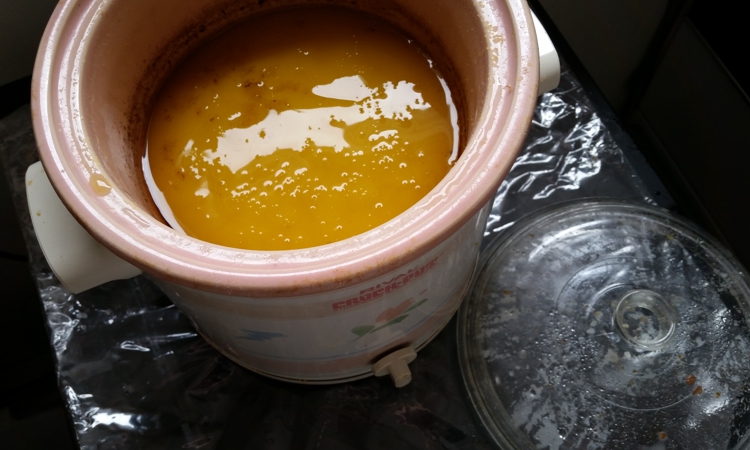
This sits all day while I periodically place handfuls of cappings wax on top. Once it melts down, I turn off the pot, let it cool, and there is my beautiful naturally golden disk of cosmetic grade beeswax. YouTube Example Here

I am not a candle maker - maybe I would be if those silicone molds were not so expensive! I did invest, however in one that makes one ounce bars. This allows me to sell by the ounce as most cosmetic makers only need an ounce or three. Do not use a mold release on your cosmetic grade beeswax. The silicone mold if kept clean should not stick. Exposing your cappings wax to a mold release of any kind is not appropriate.

Before I pour the bars they go through one more strain in a nylon stocking, rubber-banded onto a double boiler, also for cheap at a local second hand store - but I love these tools and would have bought them new if I had to for the ease they have afforded my beeswax processing routine.

Monday, March 27, 2017

My Beehive Set Up

My bees thrive well in an eight frame hive set up here in Northern New Hampshire. I tweaked the ten frame hives I'd invested in so heavily until finally, several years ago, gave in to this narrower concept. 

My bees wanted to go up, following the heat of the cluster in winter. Honey left on the outskirts of a super that would tempt them to break cluster to reach, was ignored once cold weather set in. Sometimes colonies starved.

The diseases I was seeing in my failed ten frame colonies screamed of moisture and poor ventilation; so I utilized the "varroa" screened bottom board to help with airflow. William Bonny's old book on "Hive Management" agreed with a local farmer's advice to keep a pine needle filled super on top during winter to catch moisture. That book also introduced me to homasote board. 

All these changes begun to work well, but I feared the brood box would be exposed to abrupt airflow sitting there on that screened bottom, especially going into - and coming out of - winter. 

The discovery of a swarm control component called the "slatted rack" was the next stop in my beekeeping journey. I found it perfect for buffering the brood box from the outside air. It also gave the chilly spring foragers a place to hang out in increment weather instead of crowding up into the nursery. 

The bees loved it and so do I. Setting all this on top of two leveled chimney stones cut off any direct cold air flow. It also seemed high enough off the ground to discourage skunks from scratching at the door. So did the new solar powered fencing.

After about three years of failure with southern packages and nucs queened from California stock, I began to choose northern honey bees, raised farther north than I was. I'd drive as far as I had to go. This was to try and insure overwintering survival with our uniquely short nectar flows in my mountain intervale - only five and a half months - late April to the end of September. 

In that many years the trees had also grown a few feet higher in my apiary, putting every colony in full shade. Also by that time every wasp in area knew where my hives lived. Two colonies were killed. A move had to be made. 

About then a neighbor in failing health invited me to place hives in view of his window. He lived long enough to take pleasure for a few seasons watching my bees enjoy full sun on several acres of wild forage with a northern wind break of wonderful nectar and pollen producing trees. So far most of my colonies have been able to continue in this ideal location.

These savvy acclimatized honey bees now filling my narrow hives, along with the changes made to my apiary set up, began to bring joy instead of angst to my beekeeping. I have had a few summer losses due to normal events, including beekeeper-too-busy-itis during swarm season, however, no losses winter through mid-summer like I was experiencing before. I do see mites, but not high counts others are dealing with. Most importantly, I see no diseases, and previous to these changes I think I saw them all except AFB.

I've hung in there as a beekeeper by focusing on the specific issues facing my colonies instead of trusting a lot of disparaging advice to blame every beekeeping malady on varroa mites; solve every problem with treatments. I've also looked to successful northern bee school teachers and scientist, like New England's own Tom Seeley, for insights.

Mostly I've trusted my gut. Not out of stubbornness, necessarily. On some level, though not a scientist, my ongoing studies in honey bee biology seem to say that, given a good home, these bees should be able to thrive where they live, dependent primarily on the wonderful gifts millions of years of evolution has bestowed on them.

I believe this focus has encouraged my continued research, participation in educational opportunities, and brought me satisfaction with small successes that keep me in a very difficult and expensive quest. 

I've been uncertain much of the time with my choices. I've bought miticides or antibiotics - then never had the nerve to go through with treatments. In the end, trusting my gut, paying attention to my bees, and enjoying the occasional validation of science, has so far won the day. 

I didn't know I was this person... this "scientist"; I just wanted to be a beekeeper. 

Fortunately, honey bees are a rather brilliant, persistent little species. They are determined to pull us in, teach us their needs and hopefully, in exchange for a little honey and beauty and food, survive to use a few million more years of the amazing gifts of evolution they are so marvelous at utilizing even in a dramatically changed world.